One Database.
Any Workload.
Run transactions and real-time analytics in one database.
No copies, no ETL pipelines, no separate systems.

Hybrid by Design
Process transactions and analytics in unison while keeping data consistent.

High-Performance
Rapid query results via automatic optimization and code generation.

Simplicity
No tuning, less maintenance, less operational effort.

Zero Friction
PostgreSQL compatible, no application rewrites necessary.
Run workloads your
competition can’t!
Don’t let your data infrastructure hold you back. Run every imaginable combination of analytical and transactional workloads without the headaches of synchronizing multiple systems.

CedarDB handles all your workloads with ease. No need for complex in-house data pipelines to combine and synchronize analytics and transactions.
Deep analytics that only a combined transactional and analytical data warehouse can deliver. Harness the power of high-performance analytics with transactional guarantees.
With CedarDB, there is no trade-off between analytical and transactional workloads. It excels whether you run only analytical, only transactional, or a combination of both.
One Database. No Trade-Offs.
The Database That Doesn’t Make You Choose
Without CedarDB
I need complex analytics on fresh data, but fear it will come at the cost of operational throughput.
With CedarDB
CedarDB gives every analytical query a consistent view of the data while transactions run in parallel. Full transactional guarantees keep both workloads safely isolated without requiring a separate copy of your data.
Without CedarDB
Performance is an issue, but scaling my database system is too complex, slow, or expensive.
With CedarDB
CedarDB delivers best-in-class analytical query performance without compromising transactional throughput. Just do more with one system.
Without CedarDB
My ETL pipeline constantly lags behind and cannot provide real-time insights into business-critical data.
With CedarDB
CedarDB delivers real-time insights without the need for dozens of engineers to maintain your data pipelines. Combine all your data in a single, powerful system and forget about brittle pipelines and ETL delays.
How CedarDB provides a consistent view
Fully Isolated Analytics
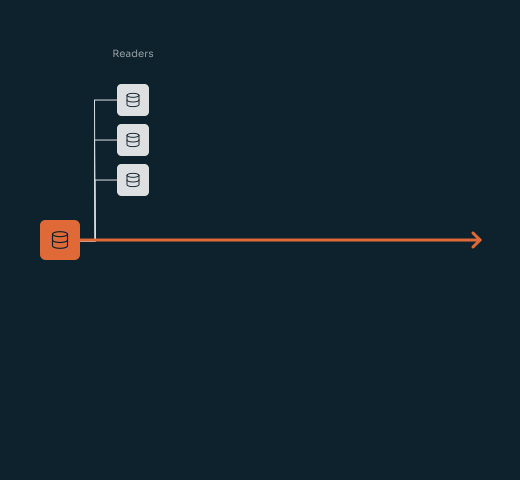
CedarDB's snapshot isolation guarantees that each reader operates on its own virtual copy of the database, completely unaffected by concurrent modifications to the data.
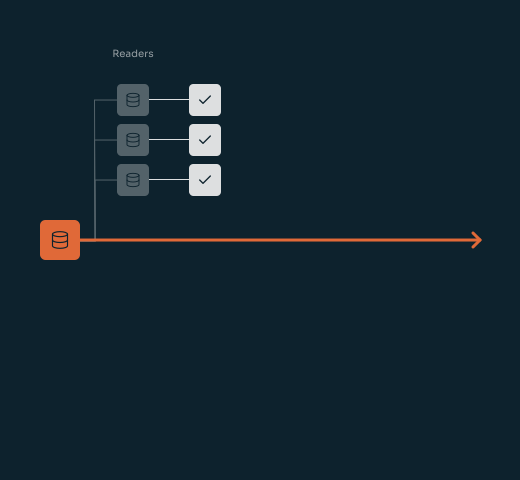
Readers Never Fail
Operations that do not modify the database always succeed, no matter how long they take, thanks to our multi-version concurrency control algorithm.
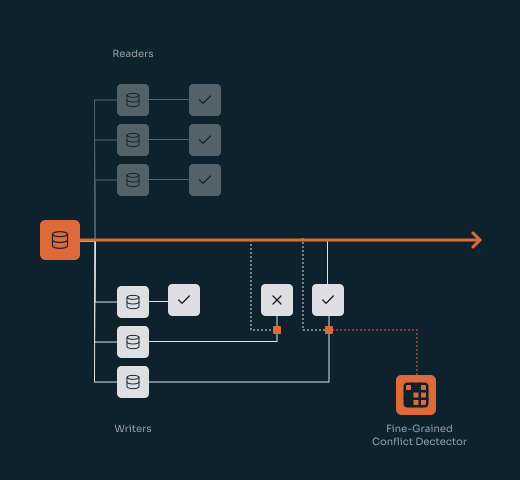
Fine-Grained Conflict Detection
Changes to the database state only succeed if they don't conflict with concurrent changes, ensuring that the state is always consistent. Our fine-grained conflict detection guarantees that only unsolvable conflicts need to be aborted.
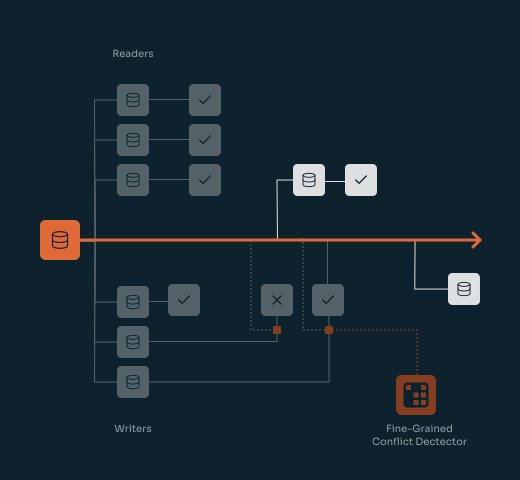
Work on the Freshest State
You can start any task at any time without worrying about competing operations. All tasks always work with the latest consistent state of your data, which guarantees fewer conflicts and fresher results.
FAQs
What is CedarDB?
CedarDB is a novel relational database for both transactions and real-time analytics on a single engine. It lets you run any workload on the same, up-to-date data without separate database systems or ETL pipelines. CedarDB is compatible with PostgreSQL’s wire protocol and syntax, making it easy to use with existing applications and tools.
Who Is CedarDB For?
CedarDB is built for teams familiar with PostgreSQL that need fast analytics on live operational data. If dashboards, reports or AI agents are pushing PostgreSQL beyond its limits, the default answer is too often an additional system. CedarDB is for teams that want to avoid that split and run transactions and analytics on the same data, in one system.
How does CedarDB compare to using separate databases for transactions and analytics?
CedarDB eliminates the need to choose between transactional and analytical performance. Its capabilities range from running an entire stock exchange to delivering leading analytical performance in benchmarks. Because both workloads run on the same, up-to-date data, there is no need for a separate analytical database or ETL pipelines to keep systems in sync.
Does CedarDB provide full ACID guarantees?
Yes. CedarDB is a true transactional database system with full ACID guarantees, ensuring transactions are processed reliably and your data remains consistent. These guarantees isolate even your most long-running analytical tasks from concurrent changes, so analytics can run on a consistent view of your data while transactions continue in parallel.
How does CedarDB scale as my workload grows?
CedarDB scales to all your use cases while running on a single machine. From your personal website running on a cheap VPS to an international stock exchange running on a server with over 100 CPU cores: CedarDB handles all scales.
How much database tuning does CedarDB require?
CedarDB is designed to deliver strong performance with no manual tuning. It automatically tunes itself by choosing efficient execution plans and indexes, while its execution engine parallelizes analytical queries across available CPU cores. You can still configure resources or add workload-specific indexes when needed, but CedarDB handles performance optimization automatically.
Can I migrate my existing PostgreSQL application to CedarDB?
CedarDB is designed to make moving from PostgreSQL straightforward. It supports the PostgreSQL wire protocol and the vast majority of PostgreSQL syntax, allowing many existing applications and tools to connect without code changes. Existing PostgreSQL data can be migrated using familiar tools such as pg_dump, psql and Parquet imports, as well as migration and replication tools such as AWS DMS and Debezium.
Can CedarDB handle JSON and vector data?
Yes. CedarDB supports both JSON and vector data alongside traditional relational data. You can store and query JSON using PostgreSQL-compatible json and jsonb types and work with vector embeddings using a vector type with pgvector-compatible syntax. This allows you to keep structured, semi-structured and vector data in the same database instead of adding specialized systems to your stack.
Which PostgreSQL extensions does CedarDB support?
CedarDB supports selected PostgreSQL extensions and extension-compatible functionality, including pgvector. Because CedarDB is built from scratch and does not share PostgreSQL’s internal codebase, arbitrary PostgreSQL extensions are generally not compatible. In many cases, however, CedarDB removes the need for extensions that work around PostgreSQL’s analytical limitations, such as pg_duckdb, pg_clickhouse, pg_mooncake, timescaledb and columnar storage extensions such as Citus Columnar. High-performance transactional and analytical processing is built directly into CedarDB instead of being added through a separate database engine or extension.
Continue reading
Read more in the CedarDB Blog

An ode to PostgreSQL, and why it is still time to start over
CedarDB is a relational-first database system that delivers best-in-class performance for all your workloads, from transactional to analytical to graph, accessible through PostgreSQL’s tools and SQL dialect. Here's the story of why we're doing what we're doing, how we got here, and why it should matter to you.

Can You Do Both: Fast Scans and Fast Writes in a Single System?
Most database systems focus on either analytical or transactional performance due to their contrasting data access patterns. CedarDB, however, achieves high performance in both areas (HTAP) with its unified storage system, Colibri, which combines compressed columnar data and row-based storage.

Stop Nesting Database Systems
Using database systems to speed up data analysis in other applications is nothing new. However, there is a surprising trend: Analytical engines are being embedded in transactional systems. Is that really a good idea?